Why Guardrails Matter
A voice agent is a production system that speaks to customers. That means reliability and predictable behavior matter as much as intelligence—guardrails define what the agent can do, what it must never do, and when it should ask for help.
Core Guardrail Patterns
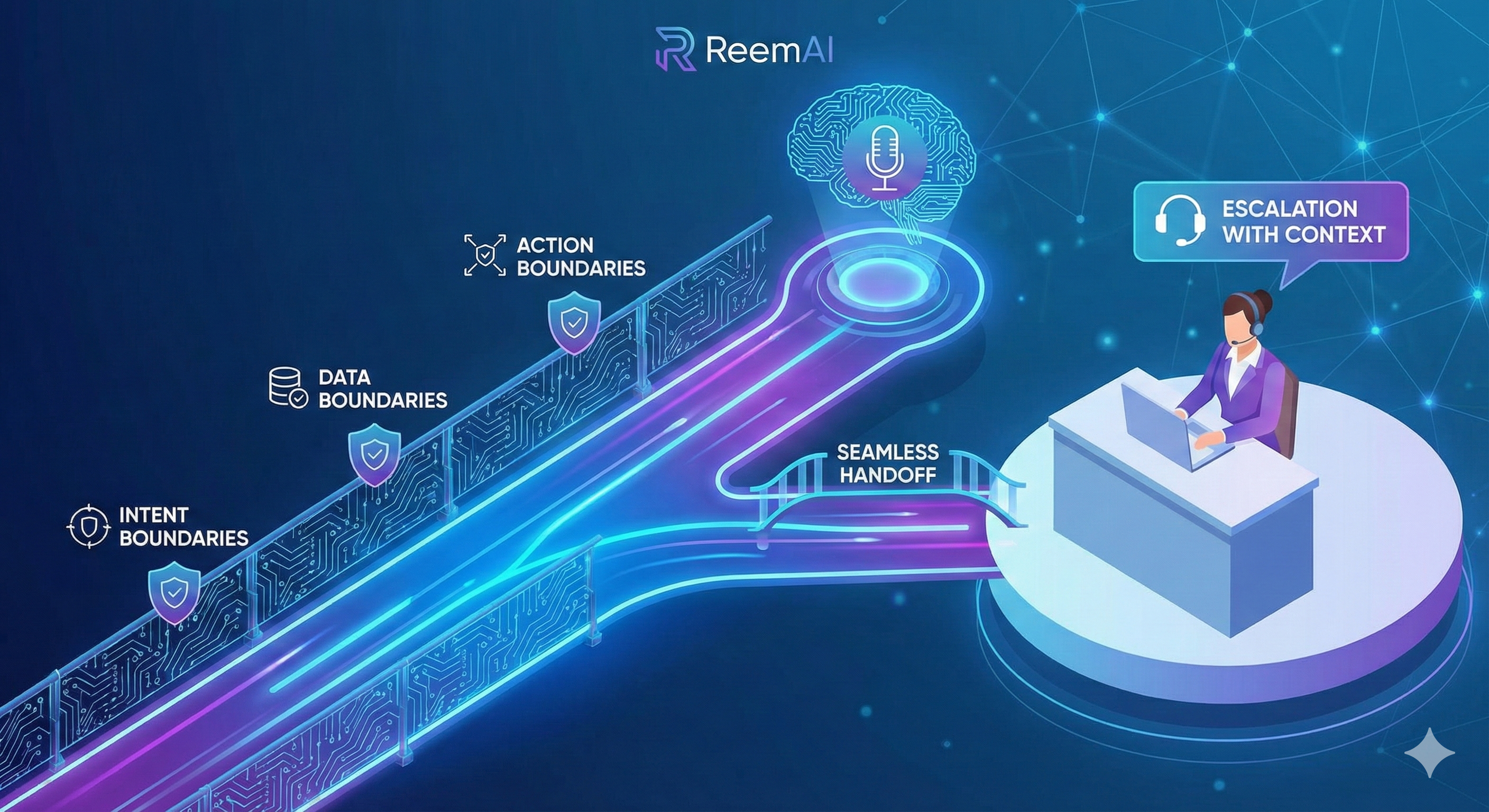
Intent boundaries
Define which intents the agent supports (billing, appointment scheduling, order status) and reject everything else with a polite redirect or escalation.
Data boundaries
Limit what personal data can be asked, repeated, or stored. Use masked confirmations (e.g., last 4 digits) and minimal data collection flows.
Action boundaries
Use “confirm-before-commit” steps for high-impact actions (cancellations, refunds, plan changes). No irreversible steps without explicit user confirmation.
Confidence-Based Escalation
Even great models will face ambiguous calls. Build an escalation policy that triggers when confidence is low, when a customer repeats themselves, when sentiment turns negative, or when verification fails.
Smart fallback prompts
Use one clarifying question at a time, restate what was understood, and offer short options so the caller can quickly correct the direction.
Escalate with context
When handing off, pass a structured summary: caller identity (if verified), intent guess, key fields captured, and what has already been tried.
Human Handoff That Feels Seamless
A handoff should feel like help—not failure. Set expectations (“I’m bringing a specialist”), keep the caller informed, and avoid asking them to repeat details.
Conclusion
With the right guardrails, escalation triggers, and handoff design, ReemAI voice agents become dependable frontline assistants—handling routine calls confidently while routing edge cases to humans with full context.
ReemAI Team
AI Voice Solutions Experts